
 Other Languages
Washington law provides specific civil rights protections for pregnant employees.
These protections apply to an employee’s pregnancy and pregnancy-related health conditions, which include health conditions during pregnancy and after the birth of the baby, such as the need to breastfeed or express milk.
If your employer has 15 or more employees, they must accommodate your pregnancy and pregnancy-related health conditions, including the need to express breast milk by:
- Providing more frequent, longer, or flexible restroom breaks;
- Modifying a no food or drink policy;
- Seating or allowing the employee to sit more frequently if their job requires them to stand; and
- Refraining from lifting more than 17 pounds.
Your employer must also provide the below pregnancy accommodations unless they can prove that doing so would constitute an “undue hardship:”
- Job restructuring, part-time or modified work schedules, reassignment to a vacant position, or acquiring or modifying equipment, devices, or an employee’s work station;
- Temporary transfer to a less strenuous or less hazardous position;
- Assistance with manual labor and lifting limits that are less than seventeen pounds;
- Scheduling flexibility for prenatal visits;
- Reasonable break time for an employee to express breast milk for two years after the child’s birth each time the employee has need to express the milk;
- A private location, other than a bathroom, if such a location exists at the place of business or worksite, which may be used by the employee to express breast milk. If the business location does not have a space for the employee to express milk, the employer must work with the employee to identify a convenient location and work schedule to accommodate their needs; and
- Any further pregnancy accommodation an employee may request, and to which an employer must give reasonable consideration in consultation with information provided on pregnancy accommodation by the Department of Labor and Industries or the attending health care provider of the employee.
Your employer may request that you provide written certification from a treating healthcare professional regarding the need for some of these reasonable accommodations, but not all. Your employer cannot request certification regarding the need for limits on lifting more than 17 pounds, flexible restroom breaks, a modified food or drink policy, the need for seating, or for break time and a private location for expressing breastmilk.
Your employer cannot:
- Fail or refuse a reasonable pregnancy accommodation that does not impose an “undue hardship;”
- Retaliate against an employee who requests, declines, or uses a reasonable pregnancy accommodation;
- Deny employment opportunities to an otherwise qualified employee because of their need for accommodation; or
- Require an employee to take leave if another reasonable accommodation could be provided.
Employers are prohibited from retaliating against pregnant employees who request one of these changes, denying employment opportunities to pregnant employees who are otherwise qualified, or requiring pregnant employees to take leave if an alternative is available. Additionally, pregnant employees with a pregnancy-related disability may have rights in addition to those listed here.
The Civil Rights Division accepts complaints that an employer has failed to accommodate an employee’s pregnancy. You may contact us at pregnancy@atg.wa.gov or by leaving a message on our toll-free line at (833) 660-4877. You may also submit a complaint using our online form and a staff member will follow up with you.
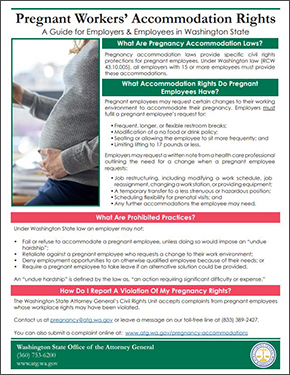
PREGNANCY ACCOMMODATIONS GUIDE FOR EMPLOYEES AND EMPLOYERS
This one-page flyer provides information about the specific accommodations required for pregnant workers under Washington state law. The flyer is designed to inform both employees and employers of their rights and responsibilities under the law, and is available in both English and Spanish.
The flyer outlines what pregnancy accommodation laws are, the rights that pregnant employees have in the workplace, which practices are prohibited for employers, and how pregnant employees can report pregnancy accommodation violations.